
Long-term spare-parts forecasting for OES decisions you can defend
Make Last-Time-Buy decisions with more confidence
Before excess stock or shortages become expensive.
When a supplier sends a part termination notice, discontinuation notice or End-of-Life (EOL) announcement, when a production run ends, or when an OEM asks for a long-term supply commitment, the hard question is not whether you need a forecast.
It is whether the forecast is robust enough to justify a decision that may affect inventory, service levels and cost for many years.
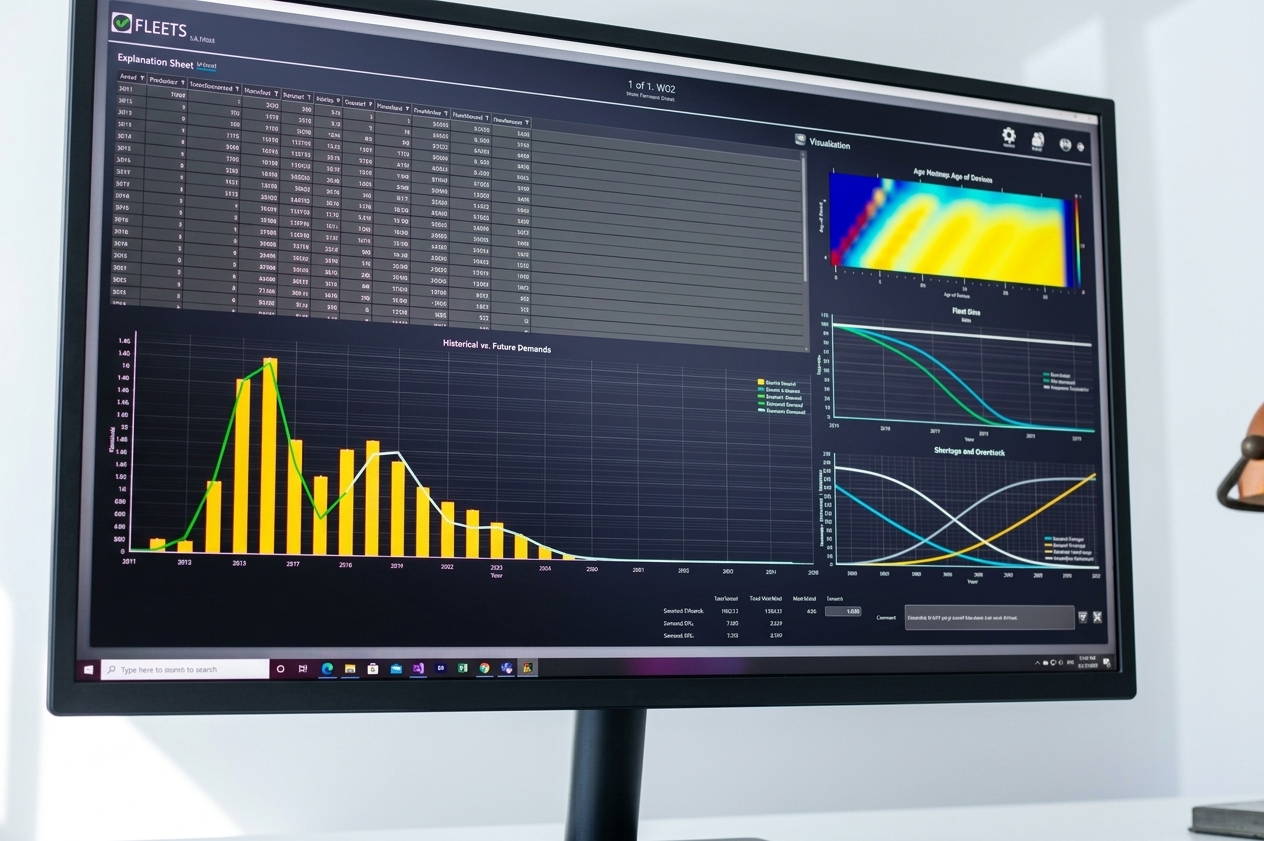
miFLEETS is a specialized decision-support solution for long-term spare-parts planning. It combines proven forecasting methods, lifecycle and replacement behavior, data-quality checks and transparent risk indicators to support automotive suppliers in Last-Time-Buy and final-provisioning decisions, part discontinuations, inventory reviews, RFQs and other difficult service-parts decisions.
Whether you are dealing with a Last-Time-Buy, part discontinuation, inventory review or another long-term service-parts decision, we can start with one real case and your existing data. miFLEETS runs locally using local files, so a typical first setup can be handled directly with the specialist team — without a large IT integration project.
20+years focused on long-term spare-parts forecasting
Developed for demanding automotive supplier use cases
Supports forecast horizons extending 25+ years into the future
Designed for both individual critical cases and high-volume forecasting
Local setup and updates using local files, typically without an IT integration project
Results remain transparent and explainable for internal review and customer discussions.
The decision is bigger than the forecast
Too much inventory ties up capital. Too little can become far more expensive.
Long-term service-parts planning is structurally different from ordinary short-term demand forecasting.
A Last-Time-Buy or final-provisioning decision may need to cover a demand horizon far beyond the available history. At the same time, the underlying population changes, products age, replacement behavior differs by application, part generations overlap, and source data may be incomplete.
A spreadsheet can calculate a number. The difficult part is deciding whether that number is plausible, how uncertain it is, and what business risk sits behind it.
miFLEETS is built around those questions.
Reduce the risk of excess stock
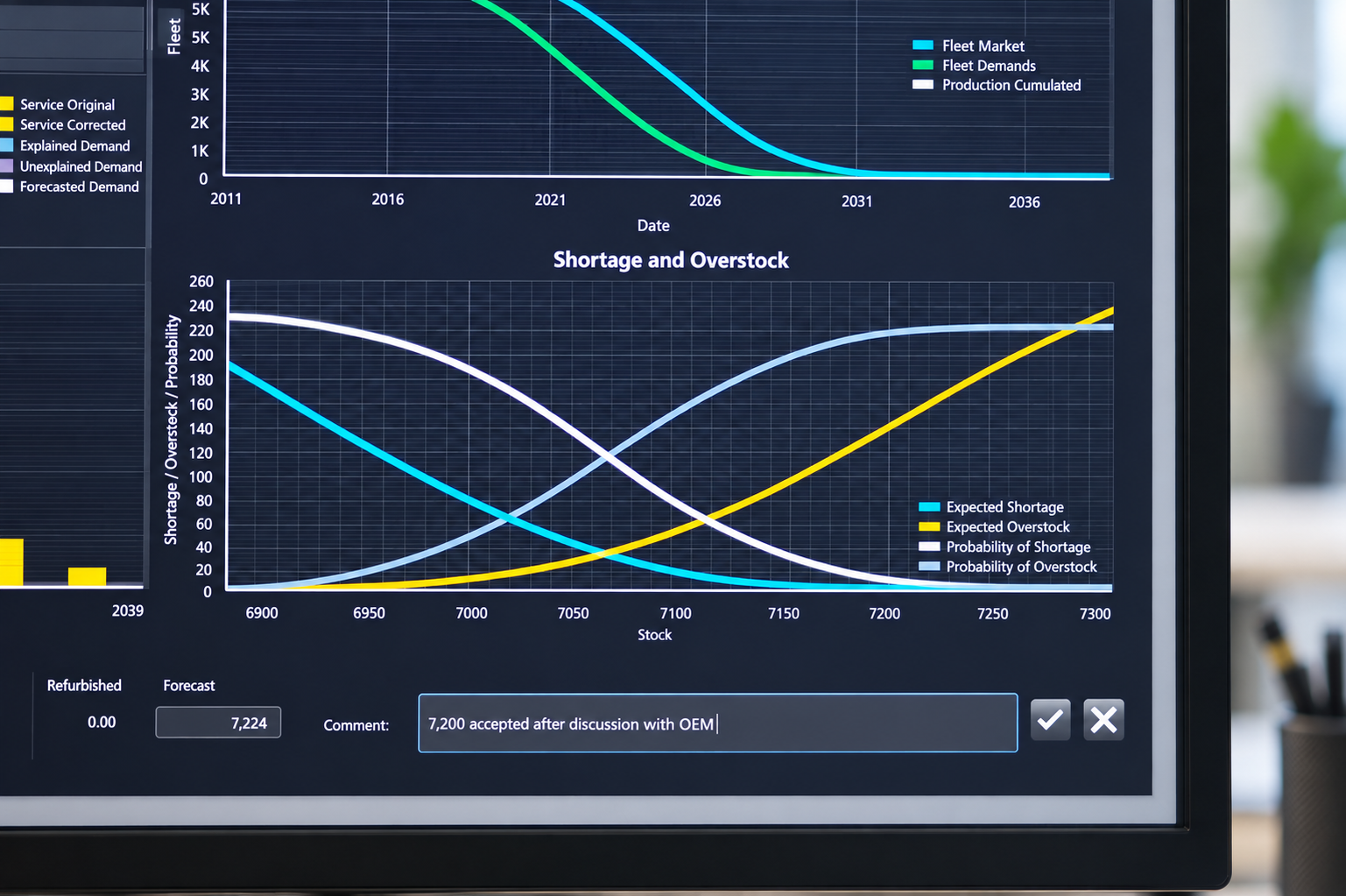
Avoid tying up capital in inventory that may never be consumed. Probability-based assessment and scenario analysis help make the trade-off visible instead of hiding it in a single point estimate.
Reduce the risk of shortages
Identify potential undercoverage early — before the remaining options are expensive re-production, redesign, requalification or difficult customer discussions.
Make decisions traceable
Document assumptions, forecast behavior, quality indicators and scenarios so that a planning decision can be reviewed and explained later.
Spend expert time where it matters
Automate standard cases and identify forecasts that require closer examination, rather than treating every part as an equally manual exercise.
Support sustainability through better provisioning
A better-aligned provisioning decision can reduce avoidable excess stock, unnecessary re-production, long-term storage and eventual scrapping. Sustainability is not a separate forecasting objective, but it can be a practical side effect of purchasing and holding closer to the demand that is actually expected.
Where miFLEETS creates value
Built for the moments where ordinary planning methods reach their limits
Last-Time-Buy / part termination / supplier discontinuation
A supplier announces that a part or component will no longer be available and the purchasing window is closing. miFLEETS helps estimate long-term service demand and evaluate the risk of different provisioning quantities.
Recurring inventory and coverage review
Existing final-provisioning inventory needs to be reassessed as actual demand evolves. miFLEETS supports regular evaluation of expected demand, shortage risk and potential overstock.
RFQ and commercial calculation
Long-term spare-parts obligations can materially affect an offer. miFLEETS supports scenario-based forecasts that make demand assumptions and long-term implications easier to substantiate.
Large portfolios
Hundreds or thousands of parts cannot all receive the same level of manual attention. Batch forecasting and quality indicators help prioritize the cases that deserve expert review.
Incomplete production history
Production or delivery quantities are not always complete or available. Specialized methods can support forecasting even when parts of the normal data basis are missing.
Special demand behavior
Wear, aging, predecessor-successor relationships, application-specific replacement behavior and other structural effects can make generic extrapolation misleading.
Many names, one decision
Different companies — and even different departments in the same company — use different terminology for this event. miFLEETS supports the provisioning decision behind all of them.
How it works
From available data to a decision-ready forecast
Start with the data you already have
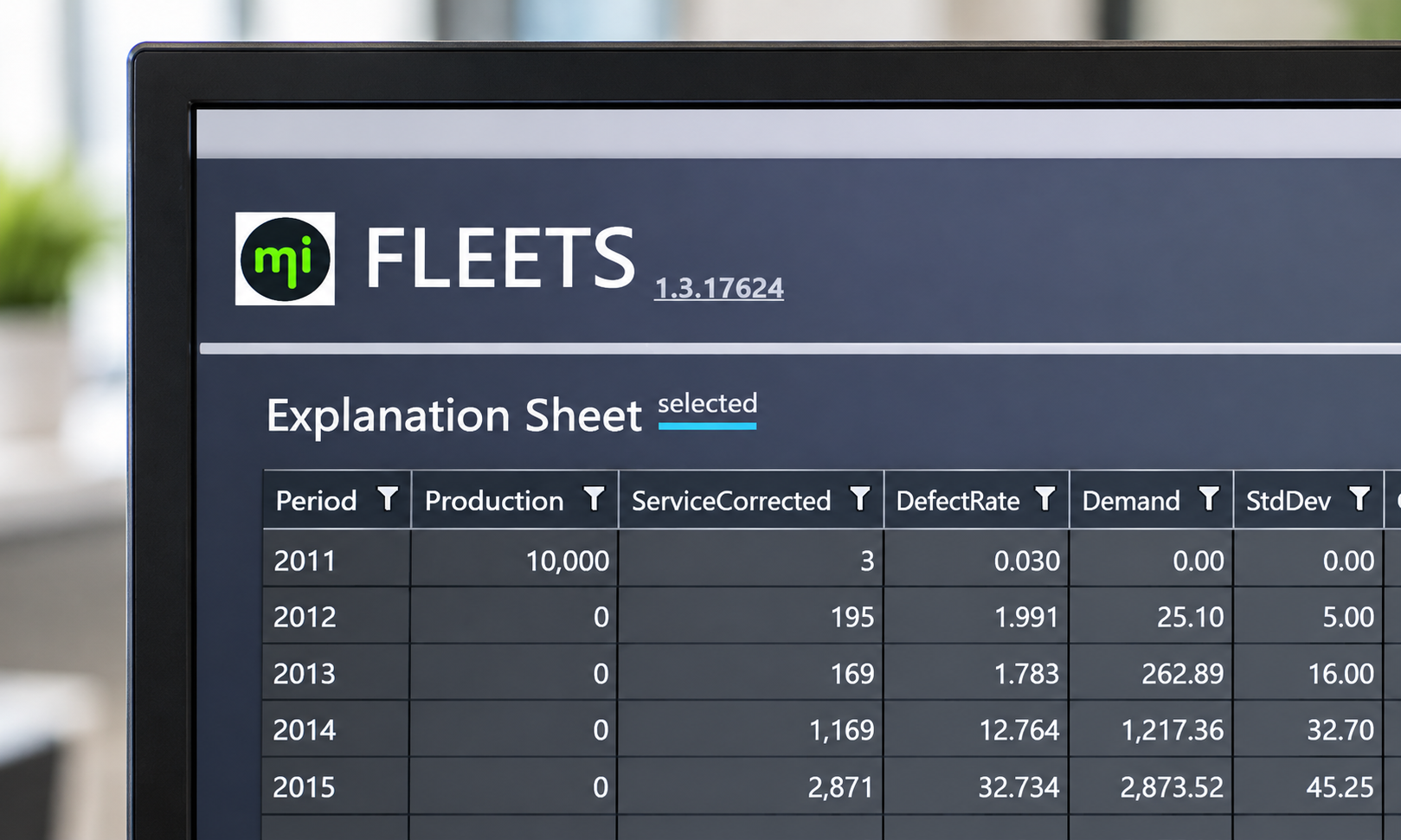
For many use cases, the starting point is straightforward: annual production or delivery quantities, annual service / spare-parts demand, relevant master data and the forecast horizon.
A structured Excel export can be enough to begin. Database connections and more automated interfaces can follow where they add value.
Check and understand the data before forecasting
miFLEETS supports analysis of the input data and helps identify anomalies, structural breaks and quality issues that could otherwise distort a long-term forecast.
Apply methods designed for long horizons
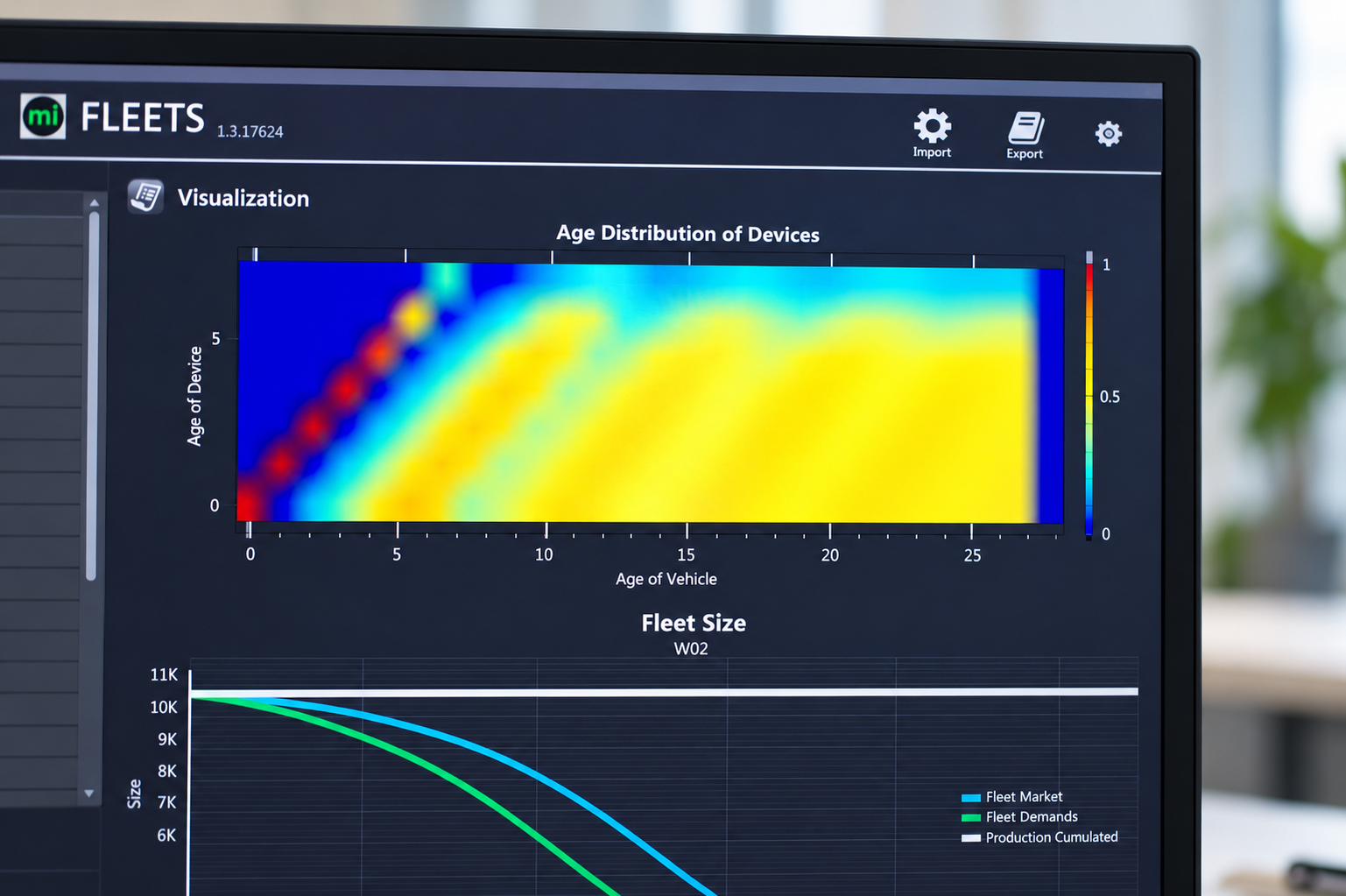
The software evaluates demand using specialized mathematical and statistical procedures that can account for fleet development, failure behavior, aging, wear, replacement behavior and other relevant lifecycle effects.
Make uncertainty visible
A forecast should not hide behind one number. Quality indicators, scenarios and risk-oriented evaluation help distinguish stable cases from those that deserve closer review.
Turn the result into a business decision
Use the forecast for provisioning, inventory review, production planning, quotation or customer discussion — with reports and visualizations that make the reasoning easier to follow.
Local by design. Fast to implement and update.
Start with local files — not an IT project.
miFLEETS runs locally and works with local files. For a standard setup, the project can typically be implemented directly with the specialist department without first creating interfaces, involving a central IT project team or changing the surrounding ERP landscape.
That also keeps updates straightforward: miFLEETS can be updated locally, and existing file-based workflows can continue to be used.
Start from familiar data
Existing Excel or other structured local files can be sufficient for the first productive workflow. The main implementation task is usually to prepare and understand the relevant forecasting data — not to build system infrastructure.
Add integration only where it creates value
If miFLEETS later becomes part of a recurring portfolio process, database connections or more automated data flows can be added where they are useful. They are not a prerequisite for getting started.
Keep the business team in control
Because the standard workflow is local and file-based, the people who own the forecasting and provisioning decisions can work directly with miFLEETS and mi Solutions. This reduces organizational friction for both new implementations and product updates.
Why not just use Excel or the ERP forecast?
Because the hardest long-term cases are not ordinary demand-planning problems.
ERP, APS and standard forecasting functions are valuable for routine planning. Excel is flexible and familiar. Neither is automatically wrong.
miFLEETS is designed specifically for this problem class. It can complement existing ERP and planning systems rather than requiring them to be replaced.
The challenge appears when a decision combines several of the following:
- only a short demand history but a very long forecast horizon
- changing fleet or installed-base size
- aging- or wear-related failure behavior
- different replacement behavior by product or application
- incomplete production quantities or master-data relationships
- predecessor and successor generations
- many parts that must be evaluated consistently
- a need to explain the result to management, finance, purchasing or an OEM
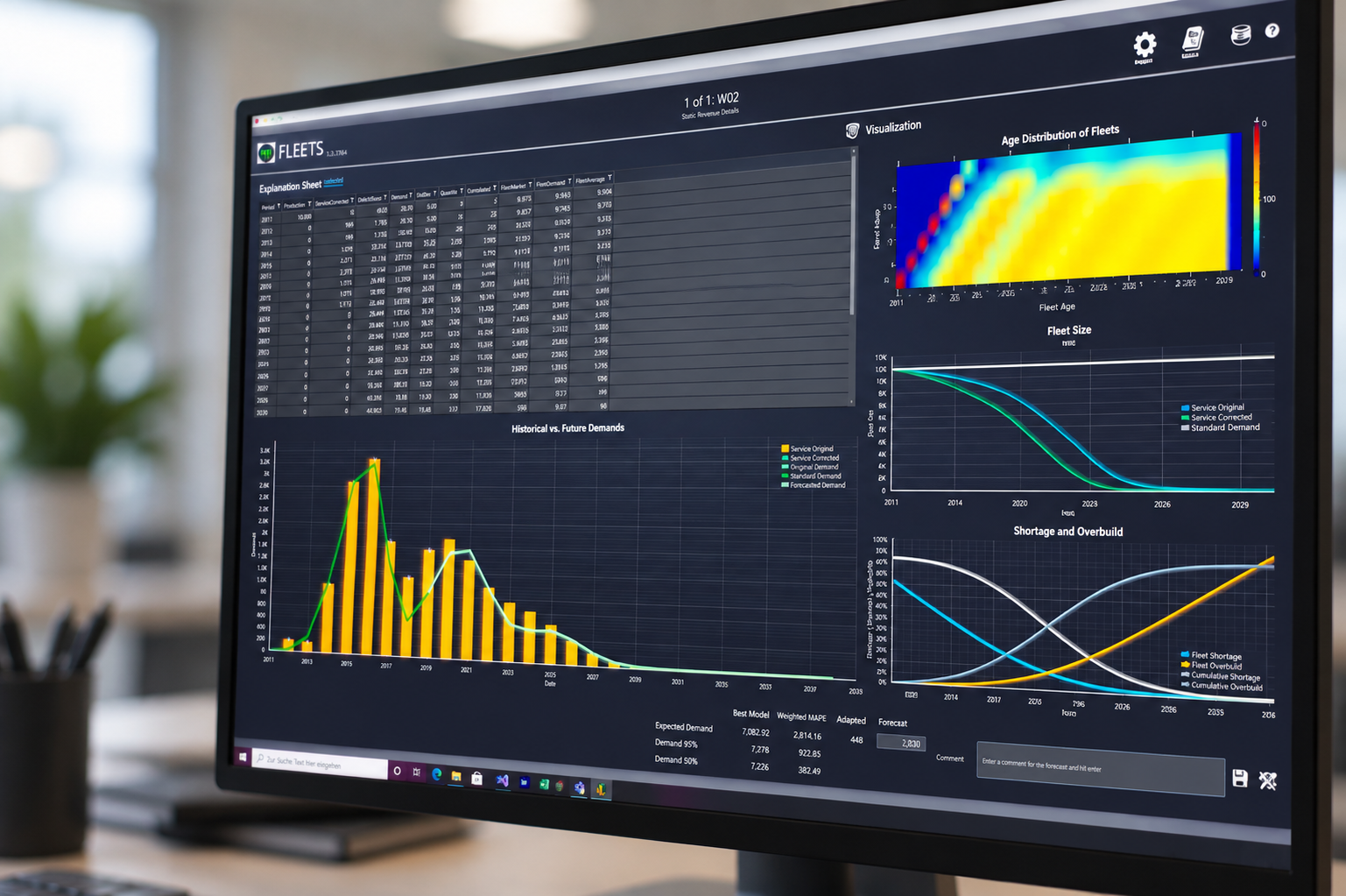
More than a point forecast
See not only the expected demand — but how much confidence to place in it.
miFLEETS can support:
- analysis and correction of forecast input data
- multiple proven forecasting approaches for long-term service demand
- equipment- and group-specific failure behavior
- aging and wear effects
- customer- and type-specific replacement behavior
- methods for incomplete or missing production quantities
- predecessor-successor and group considerations
- automated batch forecasting for large part portfolios
- quality indicators for data and forecast stability
- scenario and risk evaluation
- graphical and tabular reporting for further analysis and documentation
The purpose is not to produce the most complicated model. It is to produce a forecast that is appropriate to the decision, transparent enough to challenge, and efficient enough to use in real operating processes.
Customer evidence
From manual uncertainty to repeatable, traceable forecasting at HELLA
Before implementing miFLEETS, HELLA described a process with substantial manual effort and difficult-to-assess forecasts. Excel-based approaches and simplified calculation models could lead to over- or understocking — with the corresponding risks of tied-up capital or expensive follow-up measures.
With miFLEETS, HELLA reports that forecasts can be created more quickly and in high quality, while regular inventory evaluation and early identification of shortages and overstocks have become easier.
Implementation was also lightweight: the HELLA case describes no need for specific IT infrastructure, with the main effort concentrated on preparing the relevant input data. This is consistent with miFLEETS’ local, file-based deployment approach.
The customer also highlights the transparency and traceability of provisioning decisions, including the ability to present understandable reports in discussions with OEM customers.
“miFLEETS has fundamentally improved our workflows. Forecasting used to be time-consuming and the results were often uncertain. Now we can create forecasts quickly and in high quality.”
— FORVIA HELLA
A practical way to start
Start with one decision. Scale when the value is clear.
You do not need to begin with a full portfolio rollout.
A useful first step is to bring us a real spare-parts decision — for example a Last-Time-Buy following an upcoming discontinuation, an inventory decision based on a forecast that is difficult to trust, or a portfolio coverage review where the current process consumes too much manual effort.
We can use that case to determine:
- whether the available data is sufficient;
- which forecasting approach is appropriate;
- where the current method may be creating avoidable risk;
- what a scalable miFLEETS workflow would look like in your organization.

Jens Feller
Your contact for spare-parts decisions
Co-founder of mi Solutions and expert in the successful implementation of warehousing, inventory and demand forecasting solutions.
Discuss a real spare-parts decision
Who typically uses miFLEETS?
For teams responsible for long-term service-parts decisions
miFLEETS is most relevant when responsibility sits across more than one function. Typical stakeholders include:
Aftermarket / Service Parts / Spare Parts Management
Responsible for long-term availability, service level, inventory and operational planning.
Supply Chain / Demand Planning
Responsible for forecasting quality, repeatable planning processes and portfolio-scale execution.
Product Lifecycle / Obsolescence Management
Responsible for discontinuations, end-of-life decisions and the risks created by disappearing supply.
Purchasing / Procurement
Involved when a supplier discontinuation creates a final ordering decision or alternative sourcing problem.
Controlling / Finance
Concerned with inventory valuation, tied-up capital, provisions, excess stock and the economic consequences of planning assumptions.
Sales / RFQ / Commercial teams
Need defensible assumptions when long-term spare-parts obligations affect quotations or customer negotiations.
FAQ
Frequently asked questions
Still have a question? Talk to the miFLEETS team.
What is miFLEETS?
miFLEETS is a specialized decision-support solution for long-term spare-parts planning, built on long-term demand forecasting. It was developed around the needs of automotive suppliers and supports use cases such as Last-Time-Buy decisions, final provisioning, inventory reviews, quotations and high-volume service-parts forecasting.
What data do we need to get started?
A typical starting point is annual production or delivery quantities, annual service / spare-parts demand, relevant product master data and the desired forecast horizon. For some cases, specialized methods can also support forecasting when normal production data is incomplete or unavailable.
How difficult is implementation? Do we need to involve IT?
For the standard local-file setup, implementation can typically be handled directly with the specialist department. miFLEETS runs locally and can work with structured local files such as Excel exports, so a central IT integration project is not required to get started.
The same principle applies to updates: miFLEETS can be updated locally without redesigning the surrounding system landscape. If a recurring process later benefits from database connections or automated interfaces, those can be added separately.
How far into the future can miFLEETS forecast?
The software is designed for long-term service-parts planning and has been used for planning horizons extending up to decades. The meaningful horizon depends on the specific use case, available data and underlying assumptions.
Is miFLEETS only for Last-Time-Buy?
No. Last-Time-Buy is one important use case, but the same forecasting logic can support recurring inventory assessment, production planning, quotation, portfolio forecasts and other lifecycle-related spare-parts decisions.
The terminology around discontinuation also varies widely. A customer may describe the same situation as a part termination notice, discontinuation notice, EOL / end-of-life, component obsolescence, supplier discontinuation, lifetime buy, final buy, Abkündigung, Endbevorratung or Auslaufmanagement. miFLEETS supports the provisioning decision behind these different labels.
Is miFLEETS an AI tool?
miFLEETS should not be understood as a generic black-box AI forecast. It combines specialized forecasting procedures, domain-specific lifecycle logic, data-quality analysis and transparent evaluation of uncertainty. Modern analytical methods can support that process, but the objective is an explainable decision basis rather than an opaque prediction.
Does miFLEETS replace our ERP or planning system?
Usually not. miFLEETS is a specialist layer for long-term service-parts forecasting and difficult lifecycle decisions. Results can be used alongside existing ERP, planning, reporting and inventory processes.
Can miFLEETS process many parts at once?
Yes. The product supports automated batch forecasting and quality-oriented prioritization so that larger portfolios can be evaluated consistently and critical cases can be identified for closer review.
What if our data is imperfect?
That is common in long-running product lifecycles. miFLEETS includes procedures for input-data analysis and supports specific cases such as missing production quantities. The first step is to determine which gaps matter and which can be handled methodically.
One spare-parts decision can shape years of inventory.
If you have an upcoming discontinuation, a difficult end-of-life decision, an RFQ with long-term service obligations, or a portfolio that is still managed with too much manual effort, we can look at the case with you.
Specialized in long-term spare-parts decisions · Built on proven forecasting methods · 20+ years of product development and field use · Local software · Start with existing files · No large IT project required